• Skip to primary navigation
  • Skip to main content
  • Skip to footer
AddUp

AddUp

  • Machines
    • Machines
      • PBF
        • FormUp 350
        • FormUp 350 Evolution
        • FormUp 750 – Coming Soon
      • DED
        • Modulo 400
        • Magic 800
      • Software
        • AddUp Dashboards
      • Why AddUp
        • Customer Journey
        • Certifications
  • Service
    • Service
      • Consulting
      • Training
      • AddUp Academy
  • Industries
    • Industries
      • Medical
      • Tooling & Molding
      • Aerospace & Defense
      • Other
  • Applications
  • Resources
    • Resources
      • Guide to Metal 3D Printing
      • Blog
      • Videos
      • Events
      • Materials
      • Downloads
      • AddUp Academy
      • Customer Portal
  • Company
    • Company
      • News & Press
      • Partners
      • Careers
      • Company Locations
      • Supplier Portal
  • Contact
        • Search

  • EN
    • FR
    • DE

PBF

September 30, 2023 by

25,000+

Implants used each year that are the result of 3D printing

20+

tibial trays are printed in less than a day

10000

Annual Throughput* per 4 laser AddUp FormUp® 350

16.76

Medium, 30μm powder (hrs)* per 4 laser AddUp FormUp® 350

This case study focuses on tibia trays in orthopedic manufacturing and the challenges faced in producing highly complex and customized implants. Additive Manufacturing (AM) using biocompatible materials like titanium offers a solution by allowing the production of unique implants in a shorter time frame.

INDUSTRY

Medical

CHALLENGE

3D print a plate of tibia implants in Titanium

KEY BENEFITS
  • 3D Print customized metal parts
  • Titanium is a durable & biocompatible material
  • Quality and productivity improved
icon addup
Custom Shape
icon addup
Reduced Lead Time
icon addup
Weight Reduction
icon addup
Performance

History

To ensure the best possible patient care, modern medicine must explore the forefront of technology.  The medical industry has demanding requirements: complexity, precision of parts, customization, biocompatible materials, and durability.   One of the challenges in orthopedic manufacturing is to create an implant that has the capability to quickly integrate into the human body.  This is called osseointegration and is not easily accomplished with standard manufacturing practices today.  Some of these devices are specifically tuned to the patient’s specific need.  These devices or implants used during surgery can be customized but require extensive development time and that is not always to the patient’s advantage.  Additive Manufacturing (AM) makes it possible to produce unique, customized metal parts in a shortened time and at a reasonable price.  There are more than 25,000 implants used each year that are the result of 3D printing.  The most common material used in this process is titanium as it is one of the few materials that is both durable and acceptable to the human body.  For all of these reasons, the medical field is a key industry leading the utilization that of AM technology today.

Challenges

The purpose of an orthopedic implant is to replace a bone function seamlessly for the duration of the patient’s life. To accomplish this, the implant must fully integrate with the patient’s bone and tissue structure.  If traditional production methods are used, providing such implants and patient matched devices can be very expensive and time-consuming. Thanks to the advanced biocompatible materials available for use in AM, more and more medical applications are benefiting from this technology.  Because of their geometric complexity and need for biocompatible material, these medical parts designed by OEM’s globally are impossible to manufacture using conventional processes.

The spine industry has been utilizing AM on a mass scale for years. This is thanks to the size and quantity of implants which can be situated onto a build plate coupled with the volume of implants needed needed by the market. The next medical application emerging for AM success are tibial trays.  The challenge for tibial trays is that the throughput of standard AM machines makes the idea of producing enough implants of varying sizes and shapes improbable.  The overarching need is to have a printer that can make enough tibial trays to meet OEM demands.  Typical build plates can only hold 9-12 tibial trays.  This is not conducive to meeting industry demands without adding a significant amount of capital equipment.  Consider that the average size build plate industry wide is about 290 millimeters (11.5 inches) squared.

SOLUTIONS

AM technology can print highly complex and customized medical parts using a lattice structure to improve osseointegration, expedite production time and improve surface finish to reduce post-processing. AM allows for geometric complexity to create lattice structures for medical implants which creates a porous surface to improve bone integration while simultaneously reducing the weight of the implant. For traditional manufacturing, to achieve osseointegration it may be necessary to apply a coating to the titanium, which is expensive, time consuming, and difficult to validate.  Additionally, AM reduces the manufacturing steps and number of components, therefore cutting down production times and costs.

The AddUp FormUp® 350, a metal 3D printer using powder bed fusion (PBF) technology, showcases its capabilities through the quality and productivity output for tibia trays.

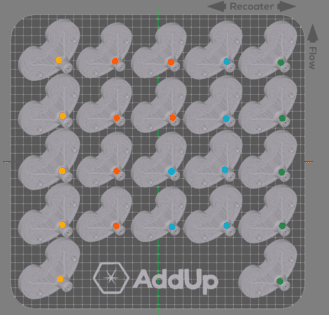
The build plate on the AddUp FormUp® 350 is 350 millimeters squared and can hold more than two times the tibial trays compared to typical build plates available.  The use of 4 lasers also offers a distinct advantage allowing 20+ tibial trays to be printed in less than a day.  Throughput is such an integral part of manufacturing today.  When space is limited and demand is high, machines like the AddUp FormUp® 350 are a welcomed technological addition. The FormUp 350 utilizes a powder roller technology which allows for geometric complexity using minimal supports and results in optimal surface finish and a reduction in post-process machining. This reduction saves time and overall production costs.

Results

The tibia tray implant manufactured on the FormUp 350 delivered a porous structure and optimal surface finish to improve overall bone integration. The extended build plate and powder roller technology allowed for increased production as well as time and cost savings thanks to less post-processing.
ANNUAL THROUGHPUT PER LASER BAR GRAPH

Running 1 shift per day for 52 weeks per year 1-1.5hrs from laser off to laser on (build flip)
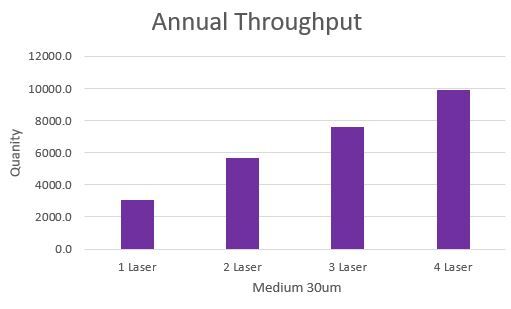
chart addup
  • Increased production – larger build plate, fewer components and fewer manufacturing steps, including less post-processing, means production times are shortened!

  • Geometric complexity – the AddUp FormUp® 350 offers the freedom to design implants to be geometrically optimized using lattice structures and overhangs, all with minimal support structures.

  • Reduction in support structures – with the AddUp FormUp® 350, extensive support structures are no longer required, resulting in less post-processing machining, and therefore saving time and costs!

  • Optimal surface finish – thanks to the powder roller technology on the FormUp 350, the surface finish is ideal directly off the printer, resulting in less post-processing time and costs!

  • Functional integration – the AM process and materials create a porous structure and ideal surface finish which improves overall bone integration for medical applications.

  • Biocompatible materials – the FormUp 350 allows a variety of different materials to be used and has already optimized Ti64ELI at both 30 and 60 micron layers.

The FormUp 350 machine is ideal for medical applications because it provides an improved and cost-effective process to mass-manufacture highly complex and/or customized medical parts.

Volume

  • Individual part: 25.604 cm3
  • Full Build Plate: 25.604cm3 * 22 parts = 563.288 cm3

Bounding Box

  • With orientation (image): 86.7 mm x 56.7 mm x 52.4 mm (XxYxZ)
1 LASER2 LASER3 LASER4 LASER
Parts built per laser22 parts11 parts7-8 parts5-6 parts
Time to build with 30-micron medium powder (melting + recoating)49.36 hours28.92 hours20.91 hours16.76 hours
Medium, 30um powder (hrs)49.3628.9220.9116.76
Annual throughput2612442460777536

September 30, 2023 by

INDUSTRY

Medical

CHALLENGE

Bringing Laser Powder Bed Fusion (LBPF) to Total Hip Replacements to reduce production costs using a multi laser system and a larger build plate

KEY BENEFITS
  • Maximum throughput with 78% OEE
  • No supports = reduced post processing = lower part cost
  • Reduced lead time
  • Fine feature resolution and optimal osseointegration for better patient outcomes
icon addup
Integrated Features
icon addup
Reduced Lead Time
icon addup
No Support
icon addup
Performance

History

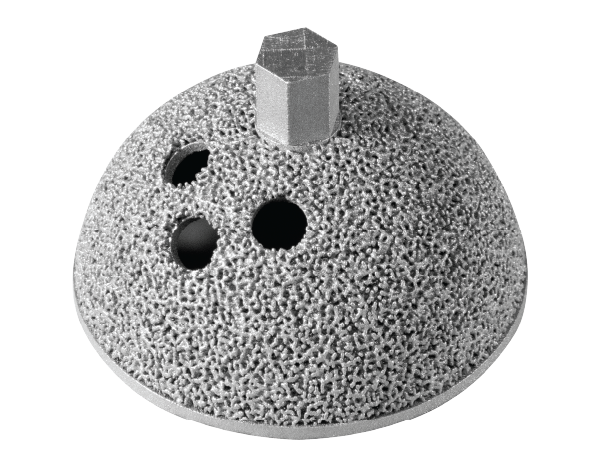
Acetabular cups are used during total hip replacements to sit against the native bone of the illum and articulates with the femur through the hip stem. Inside of the hip cup there sits a liner that connects with the head of the stem for articulation of the hip.

Acetabular hip cups are traditionally manufactured by casting and forging. This method has a long turnaround time from order to final product due to the lost wax method. This method creates a sacrificial wax mold that a shell is formed around. Then the wax is melted out of the shell and the metal of choice is poured into the shell. The shell is then broken to reveal the final part in the metal of choice. Then these acetabular hip cups must have some sort of porous structure applied to them, which is either expensive to manufacture or difficult to validate.

When additively manufactured, the part is typically printed using Electronic Beam Technology (EBM). This manufacturing process uses a stream of electrons guided by a magnetic field to melt layers of powder on top of each other. The EBM technology is subject to unpredictable failures. This is particularly unsatisfactory when multiple hip cups are being stacked onto one another in a single build. This creates a cascading effect where one failed part can result in a large amount of scrap at once. Additionally, it complicates the validation process as each layer must be mechanically validated independently.

Challenges

Casting and forging parts require a large amount of time to manufacture. This method requires foundries that are only justified with large part volumes. The long primary process along with the additional steps creates a bottleneck in the supply chain, leading to increased prices, inventory, and lead times.

Although EBM can be faster than Direct Laser Metal Sintering or Laser Powder Bed Fusion, DMLS/LPBF produces smoother, more accurate parts with no supports. Parts manufactured by EBM technology are less precise and have a higher surface roughness. This results in increased post-processing costs. Rough material on the surface must be traditionally machined away. The medical device industry is specifically sensitive to roughness that can lead to an increase in risk of build failure as the build time is longer. This does not coincide well with a technology that has a lower Overall Equipment Effectiveness (OEE).

STRATEGY

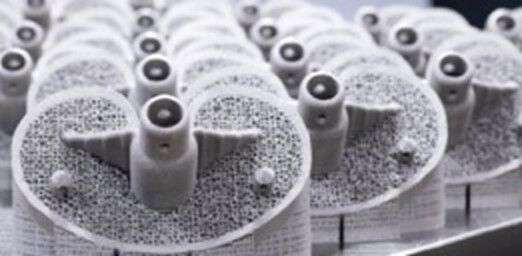
Laser Powder Bed Fusion (LPBF) technology provides a closer net shape part compared to EBM technology. There are also no supports needed in LPBF technology. All of which significantly reduces less post processing, reducing lead times. The FormUp 350 also has a larger build plate with more lasers compared to EBM printers leading to potentially more than double the throughput. AddUp’s FormUp 350 also has a fine feature resolution and a roller recoater which allows for a lattice structure printed with the implant. Lattice structures improve osseointegration which allows for longer lasting implants and better patient outcomes.

Hip cup

RESULTS

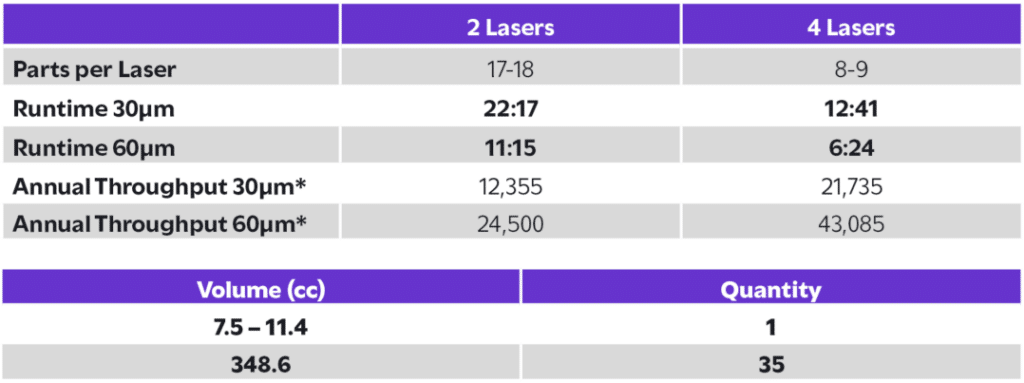
The FormUp 350 produced 35 acetabular cups in under 13 hours using 30 µm Ti6Al4V ELI, achieving a 100% part yield with no failures. Compared to EBM, the FormUp 350 demonstrated an 18% faster cycle time and supported annual throughputs of up to 43,085 cups per machine with a 4-laser, 60 µm configuration, nearly doubling EBM’s capacity. No support structures were required, reducing post-processing labor and cost while maintaining high density and surface quality. This performance translates to shorter lead times, lower part costs, and consistent, repeatable output that meets the demanding standards of medical manufacturing, evidence that serial production of critical implants is not just feasible, but proven.

Acetabular Hip Cup AM Machine Laser Compare Chart
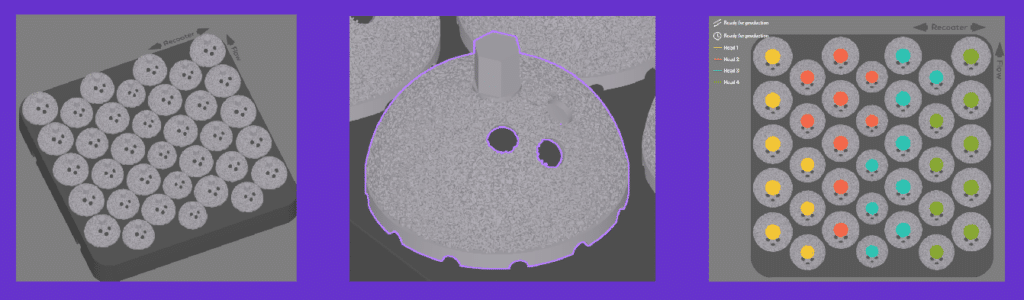
Acetabular Hip Cup in AddUp Manager

September 29, 2023 by

INDUSTRY

Aerospace

CHALLENGE

Reducing the mass and lead time while optimizing
an Aircraft Floor Bracket

KEY BENEFITS
  • 61% mass reduction of the part
  • Part printed without any supports
  • Industry leading surface finish
icon addup
Reduced Lead Time
icon addup
No Support
icon addup
Weight Reduction

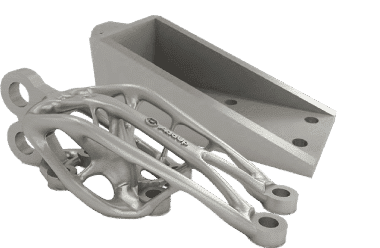
This proof of concept demonstrated by Add Up showcases the value of using Additive Manufacturing (AM) for aeronautics by applying topological optimization to an aircraft floor bracket.

History

An aircraft floor bracket secures the cabin floor to the fuselage and is present in large quantities in all aircraft. AddUp developed this proof of concept demonstrator to illustrate the value of using Additive Manufacturing for aeronautics by carrying out a topological optimization study with no supports. This part traditionally weighs around 3 kg and is typically machined from a 12 kg metal block.

Challenges

The weight of an aircraft poses various challenges, including structural integrity, fuel efficiency, payload capacity, and performance during takeoff and landing. Excessive weight can strain the aircraft’s structure, increase fuel consumption, limit payload capacity, and require longer runways.

Safety considerations, such as balance and stability, are crucial, and the cost and economics of weight must also be considered. To address these challenges, aircraft designers and operators focus on using lightweight materials, efficient designs, and operational practices that strike a balance between weight reduction, performance, and safety.

In most metal 3D printing machines, supports must be added to the part to produce surfaces with an inclination of less than 45° from the horizontal. These supports represent a significant cost and contribute to the time of part delivery.

SOLUTIONS

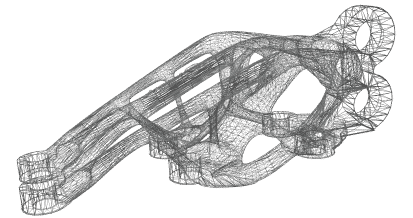
Topology optimization, the mathematical method that optimizes material within a given space with the goal of maximizing performance, was utilized to remove significant amounts of material.

First, a CAD model was created, incorporating the desired shape and the stress constraints the part needs to withstand.

Next, topological optimization algorithms evaluated the stress distribution throughout the part and systematically removed excess material from low-stress regions while reinforcing high-stress areas.

This resulted in a lightweight design that maintains structural integrity under anticipated loads. The part was then printed on the FormUp 350 powder bed fusion machine, using a fine powder and roller combo to reduce the need for supports. This combination also provided a smooth and uniform surface finish, which plays a critical role in the fatigue behavior LPBF parts and reduces the need for post-processing.

The Results

By utilizing the fine powder and roller recoater combination found only on the FormUp 350, there were no support structures required; overhangs can go as low as 30° or even 15°. By removing the need for support structures, 250 g of raw material was saved. This reduced the build time by 3 hours and saved another 30 minutes for support removal. This also lowers the overall total lead time, an important metric in the Aerospace industry.

Build Time on the FormUp 350 (at 50 μm)
11.50 Hours

Weight Reduction
From 3 Kg down to 1.17 Kg
A 61% weight reduction!

Raw Material Savings
10.83kg

Saved Time
3+ hours

September 29, 2023 by

INDUSTRY

Medical

CHALLENGE

As the world around us becomes more personalized, medicine is no different. To keep up, off the shelf solutions will become obsolete and personalized solutions will become the norm. How will the industry handle this customized changed from a manufacturing standpoint?

KEY BENEFITS
  • a net savings of US$736 per operation when using additively manufactured PSI (1)
  • a decrease in blood loss (of 44.72 mL) when using additively manufactured PSI (2)
  • a decrease in hospital stay (0.39-day decrease) (2)
icon addup
Custom Shape
icon addup
Performance
icon addup
Integrated Features

This case study highlights the advantages of using additive manufacturing (AM) for Patient Specific Implants (PSI) in the orthopedic industry. By shifting from traditional manufacturing to AM, orthopedic OEMs can meet the demand for personalized medicine and tailored solutions for patients.

History

Before the invention of industrial 3D Printing, all standard-line and even some Patient Specific Implants (PSI) were traditionally manufactured. Typically, this included manufacturing methods like casting and forging and CNC machining out of bar stock. These implants must be machined from a single piece of material (most likely titanium or stainless steel). This is a particularly expensive and technically sophisticated process. This leads to the PSI being costly and with an increased lead time.

When using AM, there are many ways that these devices can be cleared through the FDA. The easiest and most used is a 510k. This verifies a “build envelope” and ensure the PSI is functionally equivalent or better that the standard line implant. Another option is a Custom Device Exemption. This is an option that limits the manufacturing of a particular device type to 5 units per year(3). Humanitarian Use Devices (HUD) are medical devices intended to benefit patients in the treatment or diagnosis of a disease or condition that affects or is manifested in not more than 8,000 individuals in the United States per year. A Humanitarian Device Exemption (HDE) is a subset of the HUD. This type of PSI is exempt from the effectiveness requirements of Sections 514 and 515 of the FD&C Act and is subject to certain profit and use restrictions(4). These are the plethora of ways that OEMs and Manufacturers can help get the PSI into the hands of the surgeon.

Challenges

Orthopedic OEMs have been manufacturing standard line implants for mostly the same way since the 1970s. A shift to additively manufactured PSIs will change how surgeons treat their patients and will change the industry as we know it.

Conventional manufacturing, whether it be subtractive or casting and forging, is not inherently designed to make customized solutions. Therefore, the largest challenge will be convincing the OEMs and implant manufactures to change their manufacturing processes to match what the market is demanding. The market is demanding personalized medicine, and this will come in the form of PSI in the orthopedic industry.

The patients will need to work with surgeons to ensure that they receive the most tailored solution to their condition. This will also require cooperation from the hospitals and insurance companies to provide support for this industrial change. PSI can be cheaper and more beneficial to the patient, but as the technological shift occurs, PSI will most likely be more expensive. It will be up to the user, patient and surgeon, to vote with their wallet and the equipment they use to enable this technology to flourish.

SOLUTIONS

AddUp is uniquely equipped to help the industry shift from standard line implants to patient specific implants.

The FormUp 350 is built for serial production from the ground up. It can handle varying different complex geometries from fine detailed lattice that promotes osteointegration to a large semipelvis. These types of cases can all be built on a single build allowing for greater efficiency and throughput.

The modular build plate helps the manufacturer to adapt to surgical cases of any size and shape. This allows for greater efficiencies from each build. Efficiency will be key to the shift from standard product line to patient specific implants happening. As the population ages and a larger number of people live longer, there will be more and more surgeries. If medicine continues down the path of personalization, the FormUp 350 will be there to meet the demand of serial production of patient specific implants.

Lot traceability is inherently enhanced, and implants can get on to their next process faster without the need to wait on the remainder of the build. This means that each surgical case can go its own way closer to the beginning of the supply chain. A wider range of surgical implants can be produced on the same build since each implant is not subject to as many of the same processes. These further decreases lead times as PSI are especially sensitive to the amount of time between the CT scan to the surgery. Any amount of time between CT scan to surgery allows the bone’s anatomy to change as the patient continues living their day-to-day life. The less amount of time from scan to surgery, the better possible outcome for the patient; giving surgeon’s confidence that they have the correct tools for the job to best improve the patient’s life.

The Results

Using a Total Knee Arthroplasty (TKA) example, using a PSI manufactured via AM results in a net savings of $736 when compared to traditionally manufactured implants, thanks to a shorter operating time and fewer instrument trays required.(1) Patients and hospitals also reap the benefit of shorter operating room times, reduced by 20.4 min(1) when compared to traditionally manufactured implants.

It’s also been proven that a significant difference in blood loss occurs (decreased by 44.72 mL)(2) Lastly, a decreased hospital stay (0.39 day decrease) provides a significant benefit to both the hospital system and the patient. (2)

Using additively manufactured PSIs such as knee femoral and tibial components or acetabular hip cups, provide improved accuracy of biomechanical implant alignment(1), resulting in improved patient care and better patient outcomes.

References

1. Haglin, J.M., Eltorai, A.E.M., Gil, J.A., Marcaccio, S.E., Botero-Hincapie, J. and Daniels, A.H. (2016), Patient Specific Orthopaedic Implants. Orthop Surg, 8: 417- 424. https://doi.org/10.1111/os.12282

2. Schwarzkopf, Ran, et al. “Surgical and functional outcomes in patients undergoing total knee replacement with patient-specific implants compared with “off-the-shelf” implants.” Orthopaedic journal of sports medicine
3.7 (2015): 2325967115590379

3. https://www.fda.gov/regulatory-information/search-fda-guidance-documents/custom-device-exemption

4. https://www.fda.gov/medical-devices/premarket-submissions-selecting-and-preparing-correct-submission/humanitarian-device-exemption

Learn more about 3D Metal Printing for Custom Medical Implants:

September 29, 2023 by

INDUSTRY

Tooling & Molding

CHALLENGE

Increase the longevity and performance of an extrusion die while increasing the flexibility to produce dies of various sizes when additively manufactured.

KEY BENEFITS
  • Die extrusion rate for end-use product increased by 25%
  • Maximum temperature is 20°C lower on the new die due to conformal cooling
  • 6x Wear Performance: 12 weeks > 2 weeks (a 10-week improvement)
icon addup
Conformal Cooling
icon addup
Increased Productivity
icon addup
Increased Lifespan

This study explores the use of additive manufacturing, specifically Powder Bed Fusion (PBF), to create extrusion dies with improved performance and cooling capabilities.

History

Extrusion is a popular manufacturing method for parts with a constant profile. A couple examples from the world of plastics are PVC pipe and wiper blades, but metals and composites can be extruded as well. The material feedstock is forced through the profile of the die to transform it into the shape of the final part. In plastics extrusion, it is commonplace to machine the extrusion die out of aluminum. . Due to the design constraints of traditional machining, the extrusion die is often larger and bulkier than necessary, and lacks any sort of advanced cooling channels.

The simple geometry causes poor cooling performance, as the coolant cannot run near the inner profile of the die, making it way less efficient. It is also costly and time consuming to create different programs, jigs, and fixtures for different sized parts. Creating extrusion dies in specialty sizes would be too costly without the flexibility provided by additive manufacturing.

Challenges

Traditional manufacturing of extrusion dies is limited to materials that easy to machine. This material restriction conflicts with attempts to optimize performance of the die, especially when it comes to wear properties and tool life. The challenge is to utilize additive manufacturing (AM) to create a die made from a material that improves its durability and increases how long it lasts in production. The die must also utilize conformal cooling to improve thermal performance. Lastly, the overall cost of manufacturing the die must be decreased to allow for design changes to be implemented across a variety of manufacturing lines and machines.

SOLUTIONS

Powder Bed Fusion can print any 2D profile, which allows for a perfect match of any shape that may be extruded. Because PBF does not need any setup tooling, there is much more freedom with different quantities and differently shaped parts, perfect for specialty sizes and new extrusion dies without any additional investment. Extrusion dies can also be made from fewer parts, reducing spare parts burden and simplifying the manufacturing process.

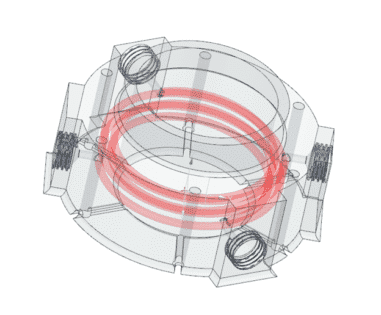
Another added benefit from the geometric capabilities of AM is conformal cooling. Intricate cooling channels, which are impossible to machine, are implemented onto the contour of the part during printing. The optimal design of these channels allows for uniform temperature control leading to improved cooling and performance. Furthermore, the part is printed in Inconel 718, which is a nickel based alloy with high wear and corrosion resistance that can operate in high temperatures.

The Results

The new extrusion die created through AM stayed of 20°C cooler than a die made using traditional manufacturing methods due to the improved conformal cooling design. The lower temperature allowed for the product to be extruded through the die 25% faster, meaning a huge productivity boost without sacrificing any quality. Thermally, there is room to increase the extrusion speed, but other equipment on the line is now the bottleneck instead of the die itself. The new die also lasted six times longer than the previous one at 12 weeks rather than 2 weeks, even while operating at the increased speed.

Powder Bed Fusion has proven to be a valuable tool, poised to support the extrusion industry for a large number of potential applications.

chart addup

September 29, 2023 by

INDUSTRY

Automotive

CHALLENGE

Decrease production time and cost while improving performance when compared to traditional manufacturing by optimizing scan strategy.

KEY BENEFITS
  • Optimized scan strategy for better surface finish for Impeller geometries
  • Proved PBF as a viable option for Impeller’s in the automotive industry in terms of both cost and performance
  • Compared test and inspection methods for geometric and density uniformity of additive versus traditional parts
icon addup
Increased Productivity

This case study explores the feasibility of using additive manufacturing, specifically the Form Up 350 PBF machine, to produce over 100,000 Impeller wheels annually for Ford, replacing traditional machining techniques.

History

Ford uses traditional methods to manufacture over 100,000 Impeller wheels per year. Ford, Oak Ridge National Labs, and AddUp conducted a study to determine the feasibility of producing the impeller wheels through additive manufacturing using the FormUp 350.

Ford would leverage their extensive history of over a century of automotive experience. Oak Ridge National Labs would optimize the scan strategy and the DOE of contour passes. AddUp brings the expertise in design, manufacturing, and automation for large scale production using their industrial FormUp 350 PBF machine.

Challenges

Ford currently manufactures by utilizing traditional machining techniques to create their impeller wheels. The challenge proposed to AddUp was to investigate the performance of PBF technology as a replacement to mass manufacture these parts. The goal was to decrease production time and cost while improving performance when compared to traditional manufacturing. Thus, a single contour pass is sufficient given a position beyond the hatch lines to remove hatch patterning. Tolerances were also sufficient from the printer.

The result should be to effectively create 100,000 Impellers through additive manufacturing and create an optimal printing strategy for performance, leveraging the design freedom from AM while optimizing the scanning strategy for surface finish and productivity.

SOLUTIONS

The original test part was made from maraging steel to test the feasibility of geometries which resulted in demonstrating the viability of additively manufacturing a complete turbo wheel without the need for supporting low-angled features. The surface finish still had to be optimized and geometric tolerances in the as-printed conditions as close to the CAD model as possible. L-PBF often uses a contour followed by infill melt strategy to obtain parts with superior surface finish. If an insufficient overlap is used between the contour and infill, it can result in porosity at the contour-infill interface thereby making the part susceptible to premature failure. The part was tested with 1 contour pass and 5 contour passes. When melting with 5 contour passes, the surface had increased porosity compared to a single pass.

The Results

With the need for a rugged, heat resistant material, Inconel 718 was chosen. When printed with Inconel 718, a support structure on the bottom of the wheel was required. AddUp printed a simulation test build of 9 impeller wheels using Inconel 718. Following post processing, two wheels were selected to be balance tested.

chart addup
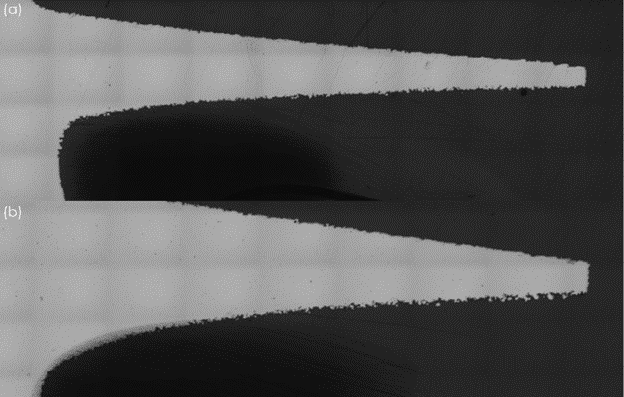
  • (a) Optical micrograph of single contour pass downskin

    (b) Optical micrograph of downskin using five contour passes. Although more contour passes may be useful, the position of the outermost contour drives surface finish as shown by partially melted particles clinging to the surface in.


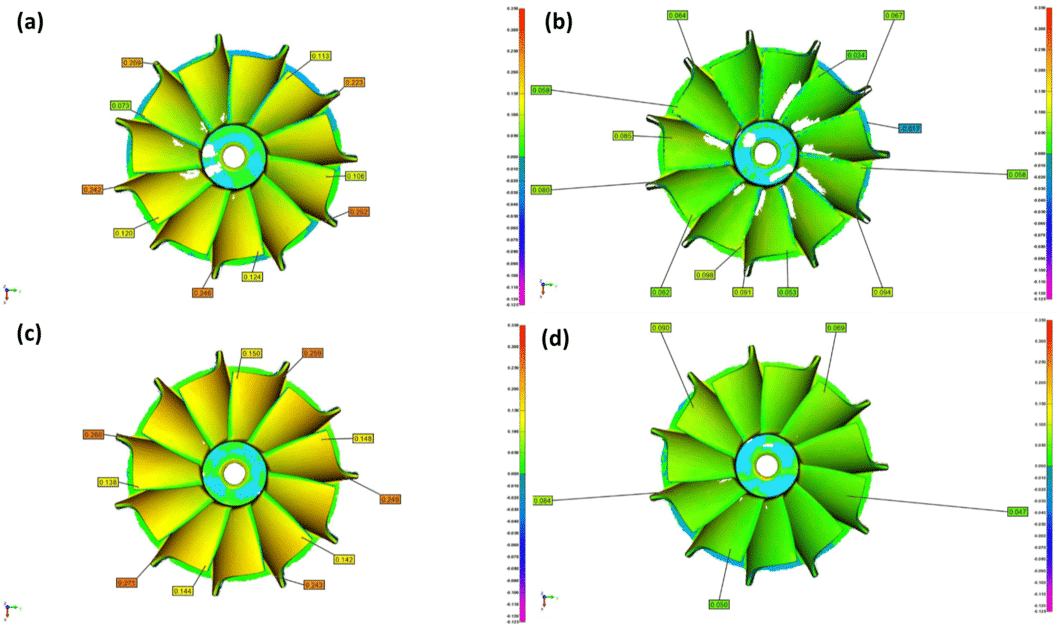
Geometric tolerances measured from light-scanning of turbo wheels with the outer contour extending the following distance beyond CAD boundary:

  • (a) #08 at 36µm
  • (b) #11 at 11µm
  • (c) #13 at 61µm and
  • (d) #19 at 36µm but melted outer to inner.
PART NAMEIMPELLER
3D printer make and modelAddUp FormUp 350
Build Plate size350 x 350 mm2
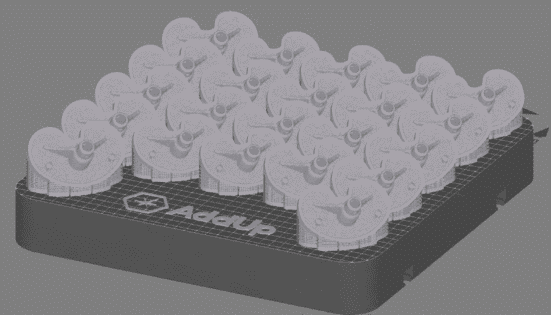
Number of parts per batch25
Print time per batch32.28 hours
Material Cost estimate for Inconel 718$70/kg
Mass of part0.311 kg
Mass of support material0.05 kg
Depowder time per batch0.5 hours
Support Removal time per batch30 hours
Post processing time per batch (heat treatment)12 hours
Annual volume required100,000 units a year
  • « Go to Previous Page
  • Page 1
  • Page 2
  • Page 3
  • Page 4
  • Page 5
  • Go to Next Page »
AddUp Headquarters

13-33 Rue Verte
ZI de Ladoux, 63118 Cébazat
France

AddUp Solution Center

5101 Creek Rd,
Cincinnati, OH 45242
USA

Footer

  • Machines
    • PBF
      • FormUp 350
      • FormUp 350 Evolution
    • DED
      • Modulo 400
      • Magic 800
    • Software
      • AddUp Dashboards
    • Why AddUp
      • Customer Journey
      • Certifications
  • Service
    • Training
    • AddUp Academy
  • Industries
    • Medical
    • Aerospace & Defense
    • Tooling & Molding
    • Other Industries
  • Applications
  • Resources
    • Guide to Metal 3D Printing
    • Blog
    • Videos
    • Events
    • Materials
    • Downloads
    • AddUp Academy
    • Customer Portal
  • Company
    • News & Press
    • Partners
    • Careers
    • Supplier Portal
  • Contact

© 2026 AddUp. All Rights Reserved. Privacy Policy| Terms of Use| Legal Notice

Ask an addup expert