• Skip to primary navigation
  • Skip to main content
  • Skip to footer
AddUp

AddUp

  • Machines
    • Machines
      • PBF
        • FormUp 350
        • FormUp 750 – Coming Soon
      • DED
        • BeAM 400
        • BeAM 800
      • Software
        • AddUp Dashboards
      • Why AddUp
        • Customer Journey
        • Certifications
  • Service
    • Service
      • Consulting
      • Training
      • AddUp Academy
  • Industries
    • Industries
      • Medical
      • Tooling & Molding
      • Aerospace & Defense
      • Other
  • Applications
  • Resources
    • Resources
      • Guide to Metal 3D Printing
      • Blog
      • Videos
      • Events
      • Materials
      • Downloads
      • AddUp Academy
      • Customer Portal
  • Company
    • Company
      • News & Press
      • Partners
      • Careers
      • Company Locations
      • Supplier Portal
  • Contact
        • Search

  • EN
    • FR
    • DE

PBF

October 2, 2023 by

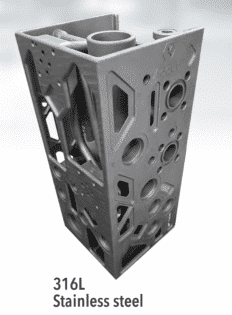
Hydraulic blocks are present in most machines and devices, throughout a variety of industries. In the case of this hydraulic block, the entire part is 3D printed in a single operation.

Hydraulic blocks are present in most machines and devices, throughout a variety of industries. In the case of this hydraulic block, the entire part is produced in a single operation. Read the case study about the advantages of additive manufacturing in 3d printing.

CHALLENGE

3D printing of an optimized hydraulic block, in one piece

RESULTS
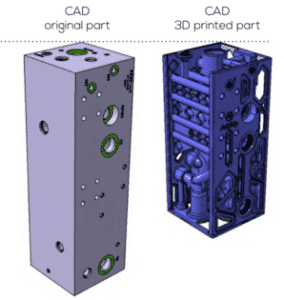
In the following case, the mass was reduced by 82% and the length of the block was reduced from 495 mm to 348 mm while keeping the functional surfaces identical. The parallelepiped shape allows for the reworking of high-precision bores.


KEY BENEFITS
  • 82% Mass Reduction
  • 30% Size Reduction
  • Creation of internal channels

Context

Dimensions: 152 x 348 mm Weight: 14 kg

Hydraulic blocks are present in most machines and devices, throughout a variety of industries: aeronautics, energy, automotive, etc. (land or naval transport, aeronautics, space, energy, etc.).

The role of these parts is to distribute fluids, often under high pressure. The mass of hydraulic blocks plays an important role in many applications and their volume depends on how they are made.

In most cases, they are made by machining blocks of raw metal. The pipes are drilled and then plugged where necessary to ensure the fluid transfer function. The changes of direction are therefore made at 90°, which generates pressure losses, and the plugs are a risk of leakage.

The Advantages of Additive Manufacturing

Metal additive manufacturing allows pipes to be made without connections or blockages, and therefore without the risk of leakage or pressure loss. The structures that hold the pipes together are kept to a minimum to reduce mass.

In the case of this hydraulic block, the entire part is produced in a single operation, with its markings and threads. This part is successful because it can be produced quickly, it is l created with less material, therefore, reducing its weight and it can be used immediately.
October 2, 2023 by

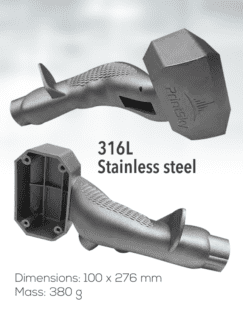
The freedom of design linked to metal 3D printing allows the production of customized handles, of different dimensions, without tooling, thus limiting the costs and manufacturing lead times of the parts.

The freedom of design linked to metal additive manufacturing allows the production of customized handles, of different dimensions, for right or left-handed people, without tooling, thus limiting the costs and time of manufacturing the parts. Read the case study about AddUp and PrintSky partnership for the 3D printing of a complex ergonomic controller.

CHALLENGE

3D printing of a complex ergonomic controller

RESULTS

Thanks to the use of a fine powder and a system of spreading the powder by a scraper, the part manufactured on the FormUp 350® machine has a low surface roughness, allowing the handle to be used immediately, without reworking.

Context

The Joystick, a multi-axis handle is specially designed for the piloting of demanding vehicles (turrets, drones, lifting equipment, etc.) combining excellent ergonomics with a wide range of applications.

For this project, AddUp partnered with PrintSky who designed the flight stick to ensure the mechanical and manufacturability characteristics of the metal part would be met. The part has been designed to allow for the dimensions to be updated to suit the shape and grip of each driver, as well as the position and type of button for each application.

The part was optimized for the Powder Bed Fusion (L-PBF*) process, reducing the wall thickness of the handle down to just 1 mm, compared to 3 mm for castings. The part was then printed on the FormUp® 350 PBF machine.

The Advantages of Additive Manufacturing

PBF technology is particularly suitable for applications that require customization, function integration, and weight savings while maintaining high mechanical strength.

This Joystick was made of 316L stainless steel and is remarkably strong and perfectly suited for off-road vehicles and machines. Its special grip makes it easy for the rider to grasp the handle. This part is a one-piece construction with modular inserts to provide design flexibility and ease of installation.

October 2, 2023 by

How reverse engineering process and metal 3D printing allow to produce an identical and durable strategic part for a boat.

CHALLENGE

Reproduce an identical part that is no longer in stock

SOLUTION

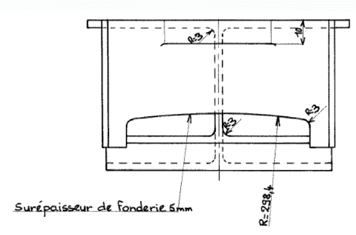
Reverse engineer the part (from a manual drawing to a digital CAD file) and additively manufacture it using the FormUp 350® Powder Bed Fusion machine from AddUp.

KEY BENEFITS
  • Tolerances: +-0.4mm, depending on demand
  • Similar mechanical characteristics, better durability
  • Overall balance of the printed part maintained
icon addup
Custom Shape
icon addup
Lead Time
icon addup
Integrated Features
icon addup
Performance

Context

Drawing of the original part

In 2018, the Ministry of the Armed Forces created the Defense Innovation Agency to promote innovation in the armed forces, with the priority to disseminate the latest technologies quickly. Under this driving force, the various services have all set up cells to boost innovation adapted to each profession. The Service de Soutien à la Flotte (Fleet Support Service), or SSF, in charge of piloting innovations for the maintenance of the French Navy’s fleet ships set up a similar initiative in 2020.

One of the French Navy’s challenges is to determine how to produce an out-of-stock part. To meet this demand, the Navy, the SSF, and the Service Logistique de la Marine (SLM, or Navy Logistics Service) needed a solid industrial group that has mastered the entire value chain. This is why the Navy turned to AddUp, a manufacturer of machines and parts, and an expert in metal 3D printing.

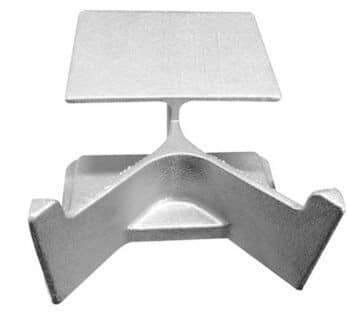
For the first test, the Navy chose an oil scraper for the propeller shaft line bearings of a Frigate, a part that plays an important role in the continuous lubrication of the bearings. This part is so essential for the operation of the Frigate and has the advantage of not presenting any critical mechanical stress for the safety of the ship, which authorizes such an experimental production attempt. Repeated contact with the splash plate and the bearing housing can lead to premature wear. This, along with the low stock of spare parts was a complementary and motivating factor for the choice of this part.

Additive Manufacturing Advantages

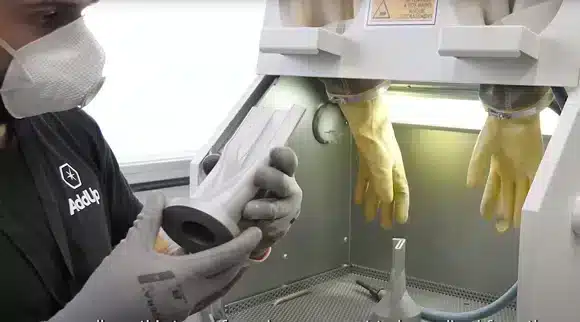
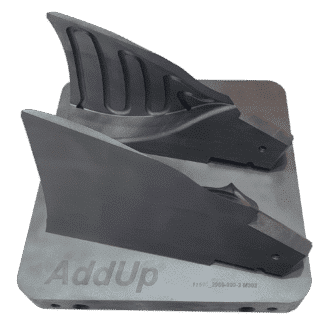
An identical part was 3D printed in aluminum. The original part was cast on a foundry layer and needed machining, which increased the production time. The new part was produced in one go, in one block, thus saving a significant amount of time. The use of a FormUp® 350 coupled with a fine powder coating roller has made it possible to produce a part with geometric precision and with a very good surface finish (superior to foundry) which has minimized the post-processing stages. AddUp has mastered the entire production chain: design, additive manufacturing, post-processing, and quality control.

“The experimentation of metal additive manufacturing with AddUp went well. The endurance tests on the ship were positive and AddUp is now referenced as a supplier of scrapers in the same way as other suppliers who produce this material using conventional techniques. The cost analysis shows that this production method is competitive. The delivery time is similar or even shorter. The collaboration was perfect and allows us to envisage other cases of application.” Jean-Marc QUENEZ French Navy Fleet Support Service Innovation

October 2, 2023 by

A one-piece optimized coolant nozzle that delivers coolant flow into precise locations. The nozzle was officially installed grinding machine, optimizing its performance.

INDUSTRY

Tooling & Molding

CHALLENGE

Traditional manufacturing of this nozzle is difficult and requires impossible internal geometries.

KEY BENEFITS
  • Optimal flow provided to cutting zone
  • Time saved – Printed in days rather than weeks
  • Monolithic for maximum strength
  • Corrosion resistance in wet nozzle application
icon addup
Custom Shape
icon addup
Lead Time
icon addup
Integrated Features
icon addup
Performance

History

Fives is an international industrial engineering group with over 200+ years of experience and has grown through various industrial revolutions to offer innovative solutions and products, boosting the performance of major industry leaders worldwide.

Fives Landis Corp., known worldwide for their leading-edge precision grinding systems, and AddUp, a joint venture between Fives group and Michelin specializing in metal additive worked together to design and metal 3D printed custom coolant nozzle.

Challenges

Using traditional production processes, fabricating this complex part is difficult and requires multiple pieces, and ideal interior geometries are impossible to create. Metal additive manufacturing allows this type of nozzle component to be realized from the digital design to the final custom metal 3D printing part in only a few steps and a matter of days, not weeks.

The custom nozzle design allows the flow position and shape to precisely match the challenging wheel geometry with fewer components in the assembly while also providing optimum flow to the metal cutting zone in the grinding machine. This increases the performance of the machine and optimizes the grind cycle.

Solution

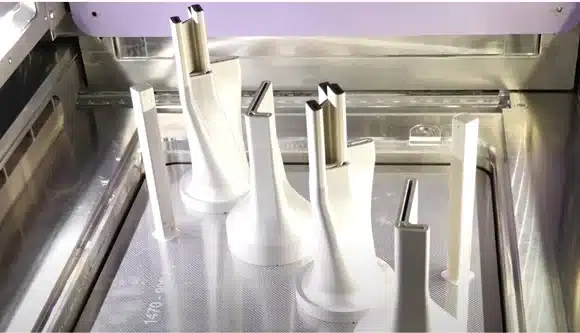
AddUp teams first started by laying out the part in the 3D build preparation software, AddUp Manager™, then developed the best manufacturing recipe for the print, including melt strategy and build orientation, before transferring the file to the AddUp FormUp® 350 Powder Bed Fusion machine.

The nozzle is printed in stainless steel using the AddUp FormUp® 350 Powder Bed Fusion machine in only a few hours. In this machine, parts are made in successive horizontal layers. For each layer, metal powder is spread across the build plate, and a laser melts the areas that need to be solidified.

Lastly, post-processing operations, including stress relief, wire EDM, and bead blasting, complete the part, making it ready for assembly on the grinding machine.

The FormUp® ensures accurate and repeatable part performance with:

  • resolution down to 0.1mm features
  • 99.99% material density
  • shallow overhangs as low as 15 degrees
  • surface finish as low as 4 Ra μm, as printed

Results

The completed nozzles installed and highlighted on the Landis LT2 grinding machine

The final result was a one-piece optimized coolant nozzle that accurately delivers coolant flow into precise locations. The nozzle was officially installed on a rebuilt Landis LT2 grinding machine, optimizing the machine’s performance.

The nozzles could deliver coolant precisely to the grinding zone for applications with complex wheel shapes. They were proved to have the required strength and integrity to withstand operating in mass production for now over one year with no failure. Examination of nozzles shows no signs of fatigue or corrosion.

October 2, 2023 by

See how this 3D printed inductor has met all quality specifications, and its industrial performance has surpassed initial expectations.

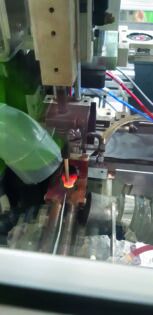
An induction heating coil is a production tool that allows performing a local heat treatment on metallic parts; in this case, it is used to braze contact tips on copper or brass parts, assembled into circuit breakers and contactors. Schneider Electric’s Plant 4.0 in Le Vaudreuil, Normandy (France), is a showcase for the new industrial revolution. Identified as one of the most developed factories in the world, it uses the latest technological advances in IloT, mobility, sensing, cloud, analytics, and cyber security. This plant manufactures 40,000 contactors per day. Read the case study about the additively manufactured inductor.

INDUSTRY

Energy

CHALLENGE

3D print a “Plug & play“ inductor with short lead time

KEY BENEFITS
  • Part with complex geometries
  • Improve metal part performance
  • Reduction of production time
icon addup
Creative Shape
icon addup
Lead Time
icon addup
Weight
icon addup
Performance

Challenges

Schneider Electric redesigned an inductor to maximize its technical and industrial performance. This new inductor was designed to reach the right temperature at the solder without damaging the pellet or the support, all while reaching the expected cycle time. This new inductor was impossible to manufacture using conventional processes, but additive manufacturing enabled it to overcome these manufacturing constraints. Schneider Electric called on AddUp to provide ease of production for this complex part and short lead times.

Schneider Electric was in search of a new inductor that could meet the following requirements:

  • Be a good conductor of current (it is the current flowing in the inductor that induces the electromagnetic field responsible for the heating)
  • Watertight (water flows through the inductor to cool it)
  • Be robust and durable (dimensional stability, service life, ability to change tools, etc.).

Solution

Using the FormUp 350, AddUp could provide an inductor based on Schneider Electric’s needs and in a fraction of the time, it would have taken to conventionally manufacture the previous version of an inductor.

Schneider Electric integrated this inductor into their production line to perform the following tests:

  • Leak test
  • Water flow measurement
  • Power up and soldering parts while analyzing hot spots with an infrared camera
  • Cycle time measurement

Following these tests, Schneider then checked the manufactured parts. In particular, the quality of the solder joints was inspected visually as well as via a pull-off test, ultrasonic inspection, micrographic section, and hardness sampling.

Results

The final result was an additively manufactured inductor successfully integrated into the Schneider Electric production line. The inductor has met all quality specifications, and its industrial performance has surpassed initial expectations.

“Additive manufacturing has enabled us to obtain a disruptive, innovative, high-performance design and a “plug-&-play” inductor. The inductor supplied by AddUp was easily integrated into our system directly, without any rework on the part. The production time was reduced, which offers a very interesting reactivity, especially for parts with complex geometry. Finally, the industrial performance exceeded our initial expectations, and the inductor has not been changed in the past four months. This is significant because a conventionally manufactured inductor is typically changed every six months. “

~ Guillaume Fribourg, Materials and Processes Expert, Additive Manufacturing Project Manager, Schneider Electric
The copper inductor installed and tested

September 30, 2023 by

This case study explores the benefits of using 3D printed injection molds with optimized cooling channels. The project between Siebenwurst and AddUp aimed to improve productivity and quality in the injection molding process.

INDUSTRY

Tooling

CHALLENGE

To improve the inserts on a mold using AM technology to increase thermal performance and decrease cycle time

KEY BENEFITS
  • Near-contour cooling in the insert
  • Reduction of time and cost production
  • Quality improvement of the molded parts
icon addup
Creative Shape
icon addup
Function Integration
icon addup
Performance

What are the metal additive manufacturing benefits of a 3D printed injection mold? A mold slide enables complex forming in the injection molding process by moving into the mold before injecting the hot plastic and moving out again after cooling to eject parts from the finished plastic part. Here, a fast cooling time of the plastic plays a decisive role in achieving more productivity. Until now, cooling channels in the moving parts of molds could only be drilled in two directions crossing each other. AddUp has integrated AM-optimized cooling channels into the sliders to thus enable faster and safer demolding.

History: model and mold making at Siebenwurst

Since 1897, the Siebenwurst Group has stood for the highest quality in model and mold making. This unique expertise is characterized by tradition and innovation. An unbroken pioneering spirit, coupled with in-depth specialist knowledge, make Siebenwurst a sought-after development partner for industry and research today. With around 700 employees worldwide, the companies generate total sales of 100 millions euros at the locations like Dietfurt in the Altmühltal, Munich, Dillenburg, Rohr near Nuremberg, as well as in Mexico,
China and the USA.

Challenges of 3D printing design

Siebenwurst worked with AddUp on a WBA project, and the challenge was to design the cooling system specifically according to AM suggestions. Then Siebenwurts should simulate the new metal part geometry for functionality using Thermo software.

These were the points they struggled with using traditional manufacturing: Complex production using multiple different pieces of equipment, increasing processing time No control of near-contour temperature. Hotspots in the mold can be reduced via near-contour temperature control. Better temperature control leads to a reduced cycle time and increased productivity offsets any additional costs from the metal additive manufacturing process.

The result of injection molding is a plastic part with less warpage and better quality. With traditional manufacturing, the parts stay in the mold for longer to allow for adequate cooling to reach the desired temperature. Now, the parts are ejected at the same temperature, which corresponds to plastic solidification, but this temperature is attained in a shorter time.

This project between Siebenwurst and AddUp confirms that additive manufacturing brings added value economically and in terms of quality. Currently, the engineers are designing parts for conventional production and not yet taking advantage of all that additive manufacturing offers.

Using a traditionally produced original part, AddUp’s experts proposed a new design to incorporate efficient internal channels. Siebenwurst then performed a thermal simulation of the part, and AddUp adjusted the channel design according to the results.

Solution for AM-optimized cooling channels

AddUp has integrated AM-optimized cooling channels into the sliders to thus enable faster and safer demolding. Using the newest simulation software and thermal design optimization, it was possible to design the cooling channels perfectly prior to assembly.

Siebenwurst used PM420 / 1.2083, a standard tool steel that AddUp can process on their LPBF (Laser  Powder Bed Fusion) machines. PM420 / 1.2083 is already common in plastic injection molding applications and well-known to mold makers.

Results and benefits of additive manufacturing

In addition to a hardness of 52HRC, this steel impresses with good corrosion resistance and also ease in polishing. Next, the new mold was produced on an AddUp’s PBF machine, the FormUp® 350 New Generation with a productive recipe using 4 lasers. Two parts were then 3D printed (1 normal + 1 opened) in 130 hours.

With the initial thermal simulation, AddUp was able to design channels as close as possible from the molding surface. The latest simulation shows that the new design descrase the hot spots by around 15°C ( 59°F ).

  • Better thermal performance
  • Cooling channel close to the surface
  • Reduction of cycle time and defects
  • Improvement of thermal homogeneity

Learn more about the Siebenwurst Group here.

  • « Go to Previous Page
  • Page 1
  • Page 2
  • Page 3
  • Page 4
  • Page 5
  • Go to Next Page »
AddUp Headquarters

13-33 Rue Verte
ZI de Ladoux, 63118 Cébazat
France

AddUp Solution Center

5101 Creek Rd,
Cincinnati, OH 45242
USA

Footer

  • Machines
    • PBF
      • FormUp 350
      • FormUp 350 Evolution
    • DED
      • BeAM 400
      • BeAM 800
    • Software
      • AddUp Dashboards
    • Why AddUp
      • Customer Journey
      • Certifications
  • Service
    • Training
    • AddUp Academy
  • Industries
    • Medical
    • Aerospace & Defense
    • Tooling & Molding
    • Other Industries
  • Applications
  • Resources
    • Guide to Metal 3D Printing
    • Blog
    • Videos
    • Events
    • Materials
    • Downloads
    • AddUp Academy
    • Customer Portal
  • Company
    • News & Press
    • Partners
    • Careers
    • Supplier Portal
  • Contact

© 2026 AddUp. All Rights Reserved. Privacy Policy| Terms of Use| Legal Notice | additive manufacturing by Fives Logo

Ask an addup expert