



The compatibility of ADAXIS’ AdaOne software with AddUp’s BeAM 400 and BeAM 800 machines provides manufacturers with an open solution for programming, simulating and optimizing multi-axis additive manufacturing operations.
Frankfurt, Germany, November 17, 2026 – At Formnext 2026, Fives AddUp, a Fives Group subsidiary specializing in metal 3D printing, and ADAXIS, developer of the AdaOne multi-axis additive manufacturing software, announce a strategic partnership in laser powder Directed Energy Deposition LASER Powder (DED-LB P).
This collaboration combines Fives AddUp’s expertise in DED-LB/P machines and processes with ADAXIS’ capabilities in programming, multiphysics simulation and manufacturing supervision. Their shared ambition is to make DED more integrated and easier to implement through better connectivity between software and machines. This complementary expertise translates into a simpler transition from part geometry to a controlled, repeatable deposition operation that meets the requirements of industrial production.
A new software environment for AddUp BeAM machines
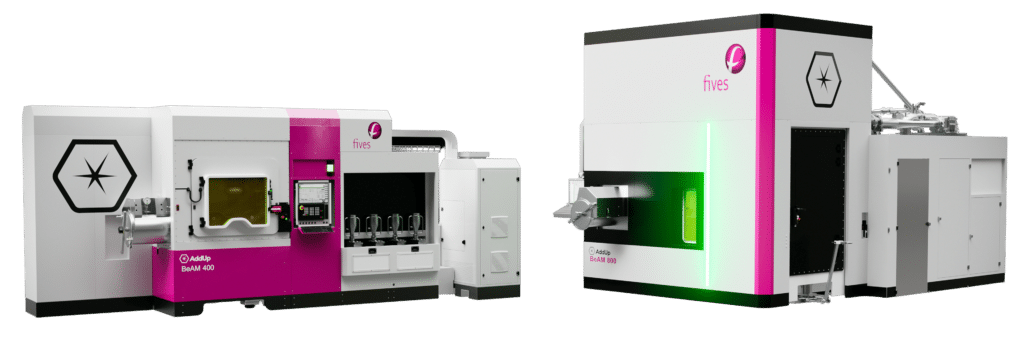
Through this partnership, users of AddUp’s BeAM 400 and BeAM 800 machines can now prepare their operations, generate complex multi-axis toolpaths, simulate machine movements and create programs within the ADAXIS AdaOne environment.
This integration provides manufacturers with a new software solution for programming DED-LB/P operations. It offers greater flexibility in the choice of digital tools while maintaining a high level of control over toolpaths and manufacturing quality.
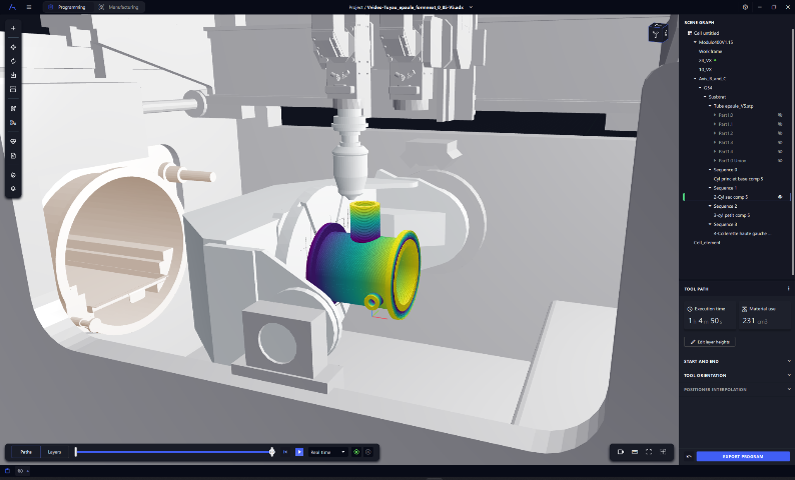
The two partners will also work to strengthen communication between AdaOne and BeAM equipment. The aim is to facilitate access to machine and process parameters, ensure more reliable program transfer to the CNC controller, and simulate the machines’ actual kinematics and toolpaths as accurately as possible within the AdaOne environment.
Thomas Elcrin, Process and Applications Manager, Fives AddUp: “This partnership with ADAXIS illustrates Fives AddUp’s commitment to providing an open and flexible software ecosystem for industrial additive manufacturing. By integrating our BeAM 400 and BeAM 800 DED machines into ADAXIS’ AdaOne software, we are giving our customers a new high-performance solution for programming, optimizing and simulating their DED toolpaths. This collaboration also strengthens the capabilities of our Laser Technical Center, where AdaOne’s advanced toolpath generation and simulation features will support the development and validation of new laser applications.”
Guénolé Bras, Chief Technology Officer, ADAXIS: “The challenge of DED is no longer simply to generate toolpaths, but to control what actually happens during deposition. By combining AddUp’s process knowledge with AdaOne’s digital capabilities, we aim to advance programming, simulation and the use of machine data. This practical collaboration between two French areas of expertise helps make DED technology more integrated and more accessible to manufacturers.”
Developments focused on the realities of the DED process
The joint roadmap will focus on integrating physical phenomena specific to laser powder DED-LB/P into the AdaOne environment, including variations in laser power and powder flow rates, process speed variations caused by actual machine acceleration and deceleration, and thermal accumulation resulting from the DED-LB/P deposition process.
Developments will focus on:
- creating toolpaths that account for the actual behavior of the machine and process;
- thermal simulation applied to actual manufacturing conditions;
- using machine parameters and sensor data;
- programming Functionally Graded Materials (FGM) using AddUp’s BeAMix technology.
This approach is intended to reduce trajectory development phases, improve process repeatability and facilitate the deployment of economically viable DED applications. Target use cases include the repair of high-value components, cladding, the addition of features and multi-material manufacturing.


